A Japanese bodysuit — horimono (彫り物) — is defined on two axes: the length format (how far the arms and legs are inked) and the front cut (donburi or munewari). Together they name every standard layout, from the full Soushinbori Donburi to the minimal Mijikame no Munewari. Below is each format, shown front and back — every photo generated with Inkeify, so you can preview your own before you ever sit for the needle.
Length formats
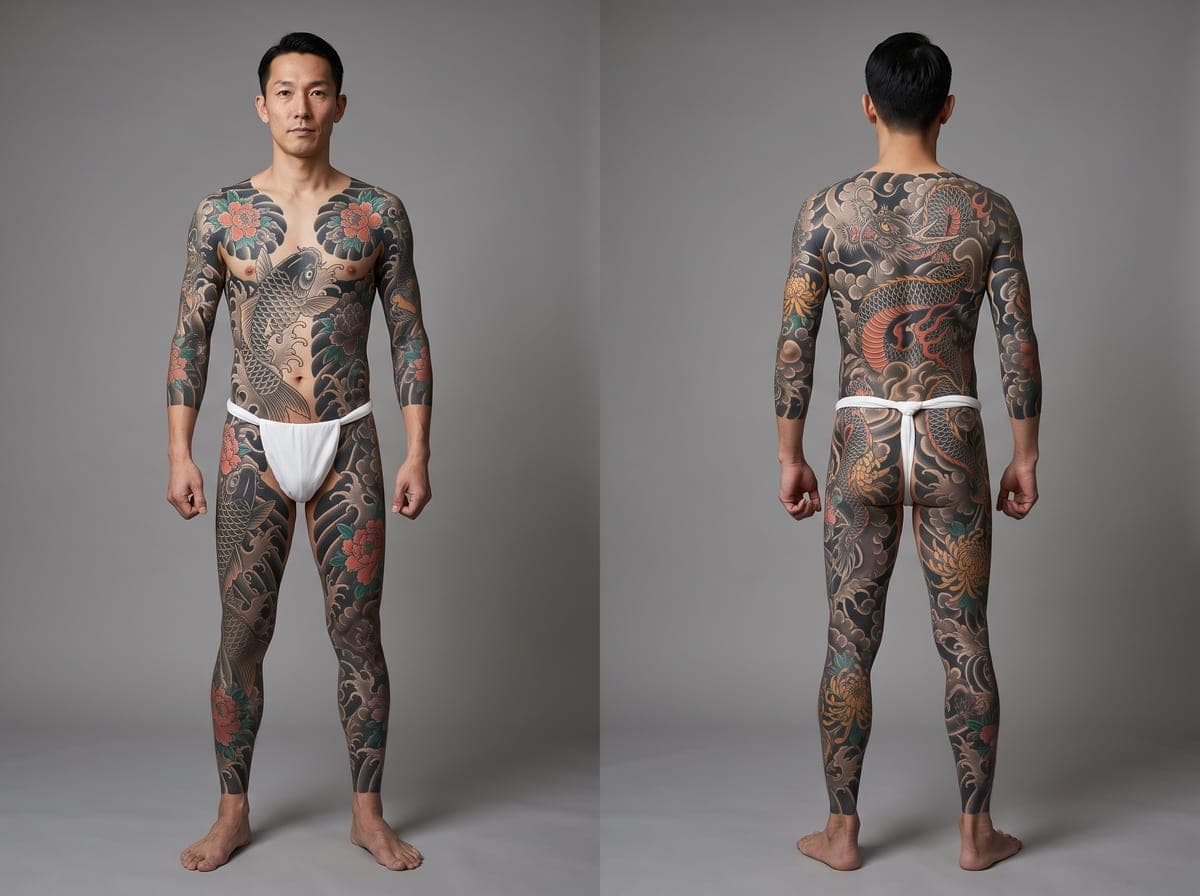
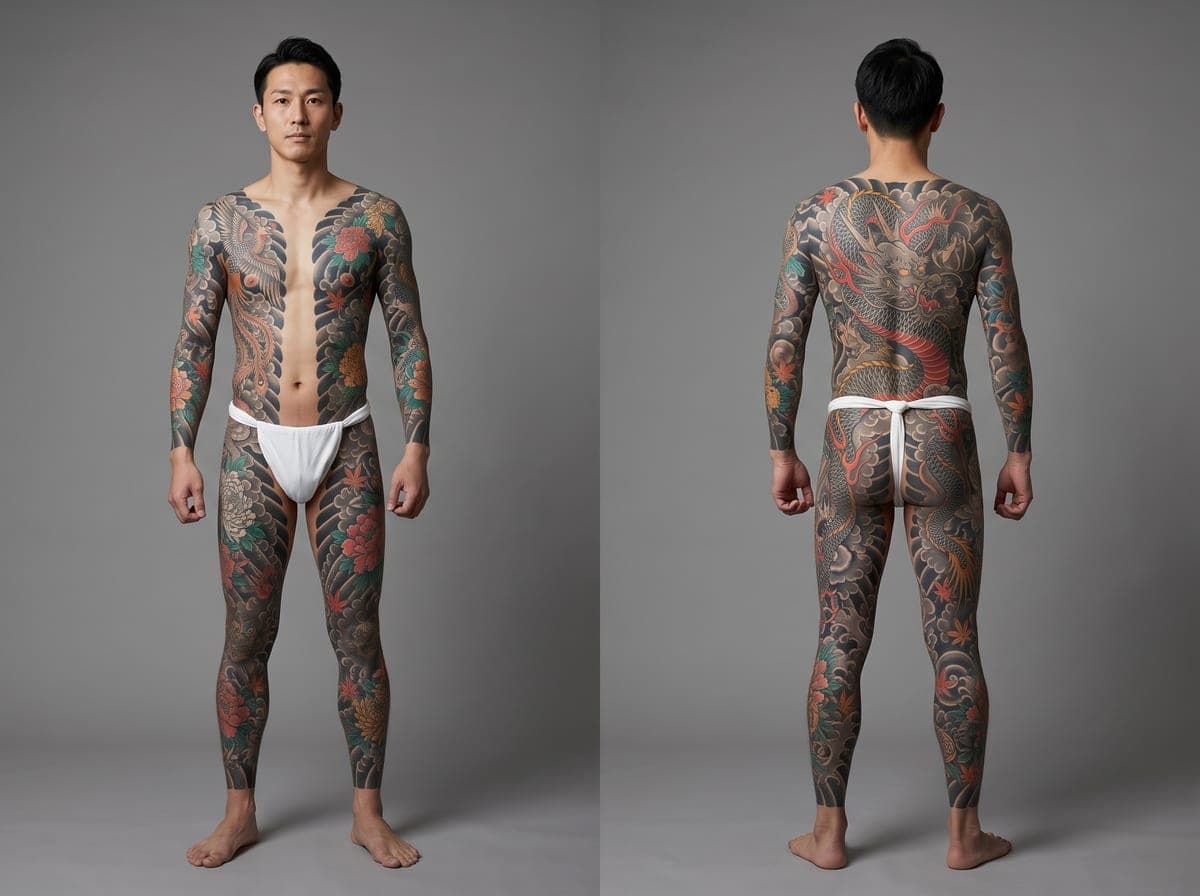
Soushinbori 総身彫りFull length — arms to the wrist, legs to the ankle. The complete bodysuit.
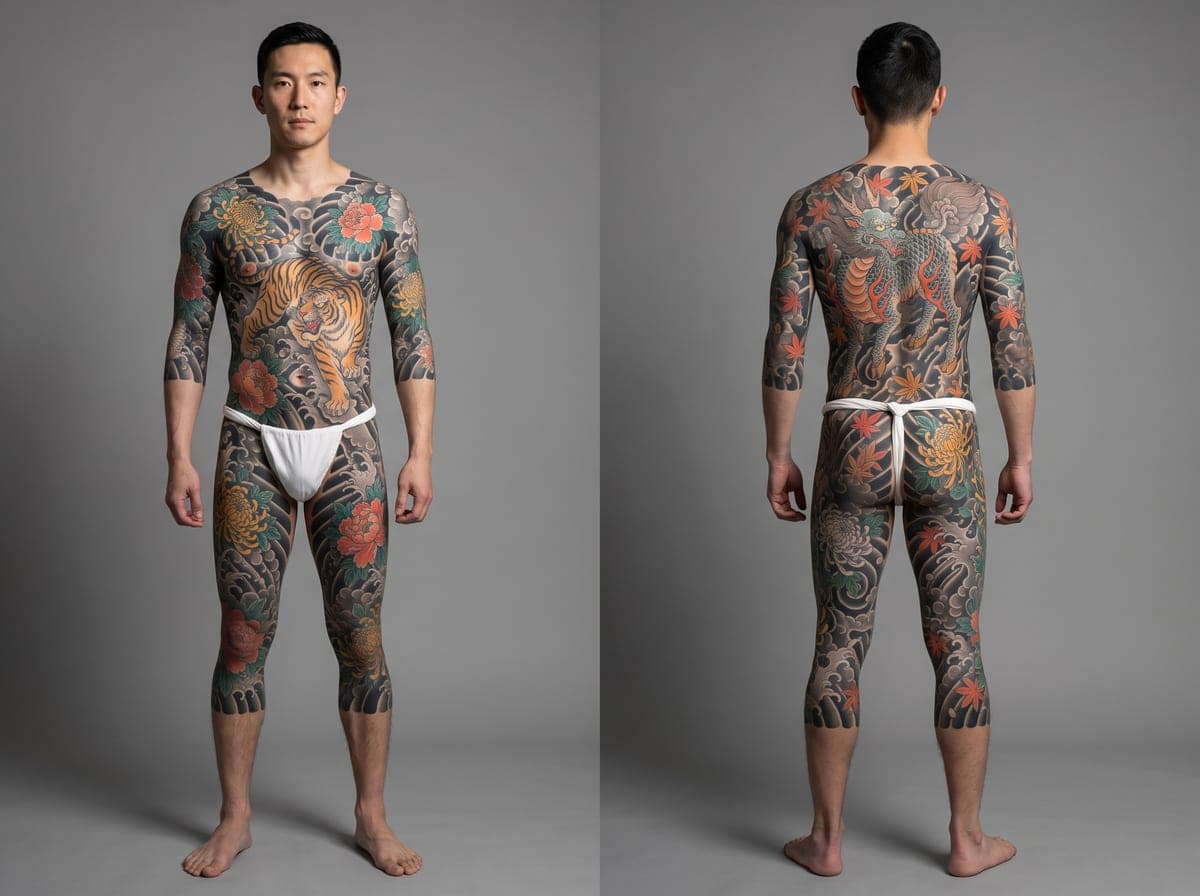
Shichibu 七分Seven-tenths — arms end a few inches below the elbow, legs below the knee.
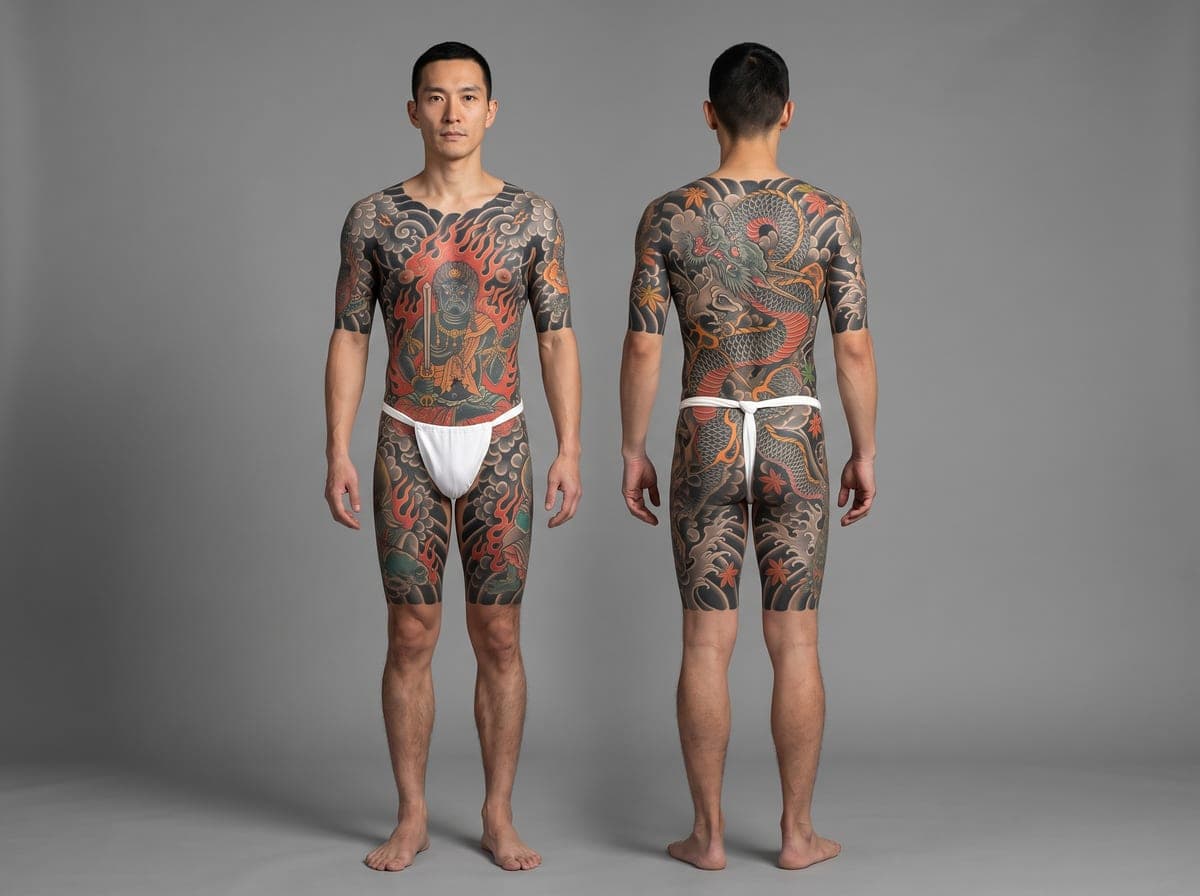
Gobusode 五分袖Half (5/10) — sleeves above the elbow, legs above the knee.
Mijikame no Munewari 短め胸割りShort, minimal coverage — cap sleeves and mid-thigh, keeping the munewari split. Traditionally for women.
Front cuts
Donburi どんぶりFull front — a dominant motif fills the whole chest and stomach with no bare gap, rising to a continuous tattooed collar.
Munewari 胸割りSplit front — a clean bare strip runs down the centre of the chest and stomach, so the suit hides under an open shirt.
Hikae ひかえChest panels that extend from the sleeves over the pecs — often the first step, framing a future donburi or munewari front.
The formats
Soushinbori Donburi
総身彫り・どんぶり
Full length · Donburi (full front)
Front & back · Arms to the wrist, legs to the ankle; full unbroken front.
The most complete bodysuit there is: full length down to the wrists and ankles with a completely filled front (donburi). The dominant motif fills the chest and stomach with no bare centre, rising to a continuous tattooed collar. Only hands, feet, neck and groin stay bare.
Soushinbori Munewari
総身彫り・胸割り
Full length · Munewari (split front)
Front & back · Arms to the wrist, legs to the ankle; bare strip down the centre front.
Full-length coverage with the traditional split-chest cut — a clean bare channel runs down the centre of the chest and stomach so the suit can be hidden under an open-necked shirt. Maximum coverage with classic discretion.
Shichibu Donburi
七分・どんぶり
7/10 length · Donburi (full front)
Front & back · Arms to mid-forearm, legs to mid-shin; full front.
A seven-tenths suit: the sleeves end a few inches below the elbow and the legs below the knee, with a full donburi front. Slightly easier to conceal than a full suit while still reading as a complete bodysuit.
Shichibu Munewari
七分・胸割り
7/10 length · Munewari (split front)
Front & back · Arms to mid-forearm, legs to mid-shin; split front.
The seven-tenths length with the split-chest cut — historically a popular balance of commitment and discretion, ending below the elbow and knee with the bare centre channel on the front.
Gobusode Donburi
五分袖・どんぶり
Half length · Donburi (full front)
Front & back · Arms above the elbow, legs above the knee; full front.
A half-length (5/10) suit: sleeves stop above the elbow and the legs above the knee, with a full donburi front. The classic 'T-shirt and shorts' bodysuit — completely hidden in everyday clothing.
Gobusode Munewari
五分袖・胸割り
Half length · Munewari (split front)
Front & back · Arms above the elbow, legs above the knee; split front.
Half-length with the split-chest cut — the most discreet of the standard formats, pairing short sleeves and above-the-knee coverage with the bare munewari channel.
Mijikame no Munewari
短め胸割り
Short length · Munewari (split front)
Front & back · Short cap sleeves, legs to mid-thigh; split front.
A deliberately short, minimal format — cap sleeves high on the upper arm and coverage only to the mid-thigh, keeping the split-front munewari structure. Traditionally chosen by women who find the longer formats too much.
Horimono terms to know
Horimono 彫り物Traditional Japanese full-body tattooing as one unified composition. All horimono is irezumi, but not all irezumi is horimono.
Kame no Koh 亀の甲'Turtle back' — a full back composition from the nape down to the back of the thighs; the classic back-first foundation of a suit.
Mikiri 見切りThe framing/border that defines where the tattoo ends — the deliberate agari edge on the arms and legs.
Gakubori 額彫りThe background — waves, clouds and wind-bars that fill the gaps so the whole suit flows as one piece.
Sujibori / Bokashi 筋彫り / ぼかしThe black linework (sujibori) laid first, then the soft gradated shading (bokashi) that gives irezumi its depth.
They're defined on two axes: the LENGTH format — soushinbori (full), shichibu (7/10), gobusode (half) and the short mijikame — and the front CUT — donburi (full front) or munewari (split front). A back-first foundation is called kame no koh.
What is the difference between donburi and munewari?
Donburi fills the entire front torso with no bare gap. Munewari leaves a clean bare strip down the centre of the chest and stomach so the suit can be concealed under an open shirt.
What is the difference between soushinbori, shichibu and gobusode?
They describe how far the arms and legs are inked. Soushinbori runs to the wrist and ankle; shichibu (7/10) ends below the elbow and knee; gobusode (half) ends above the elbow and knee.
Is a half-length suit still a real bodysuit?
Yes. A motif that ends above the knee and elbow is considered just as much a proper bodysuit as one ending at the wrist and ankle — what matters is that it's planned as one unified composition.
Can I preview a bodysuit before committing?
Yes — Inkeify lets you choose a format and motifs and generate photorealistic previews on a body before you ever sit for the needle.
Design your own bodysuit
Pick a format and motifs, then generate photorealistic previews on a body — free to start.