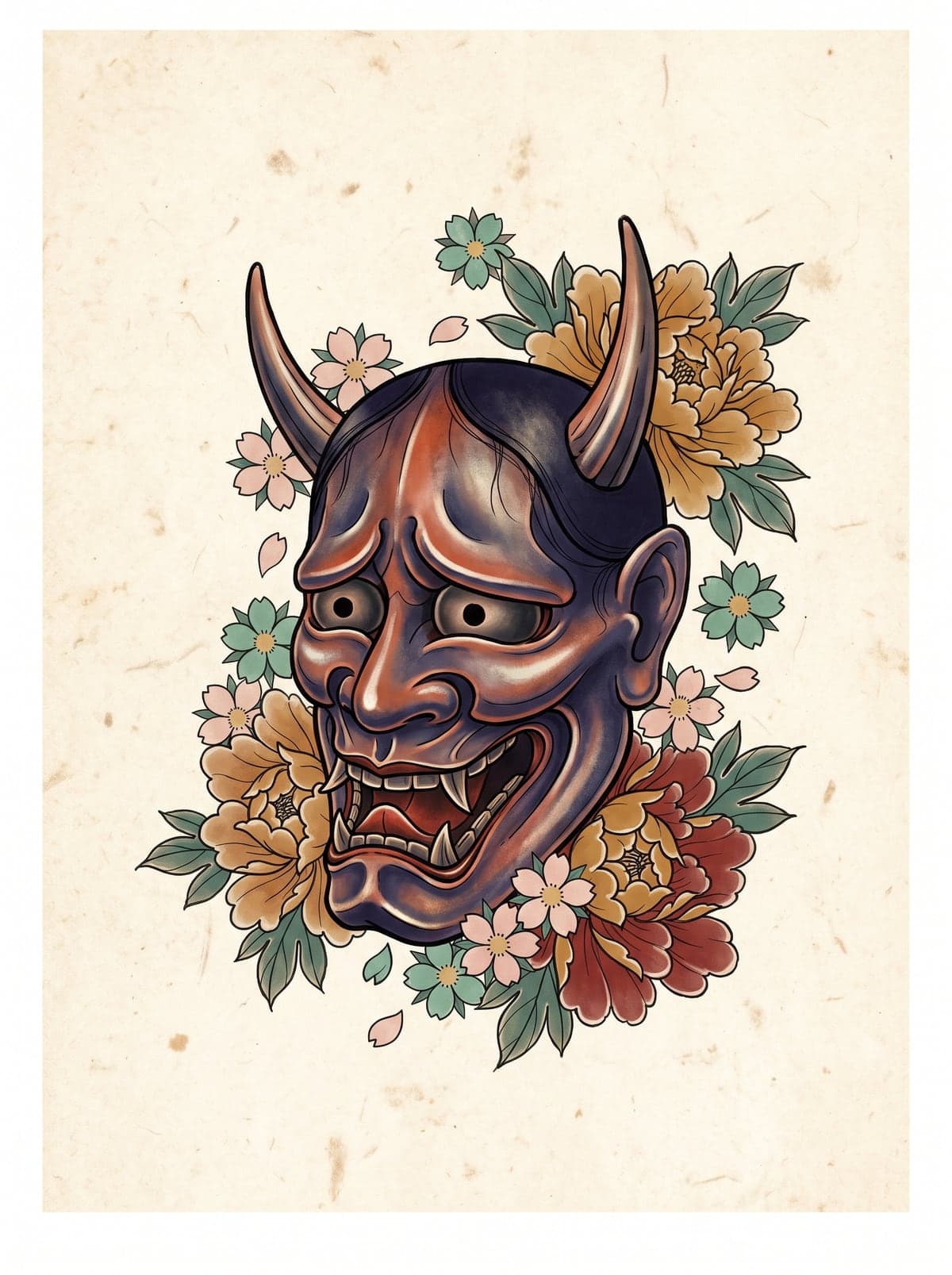
Hannya Mask (Hannya) — original Inkeify art plate in the ukiyo-e tradition.
Meaning & Symbolism
Jealousy, rage, obsession, suffering of attachment. The hannya represents a woman consumed by jealousy who has transformed into a demon — a warning about destructive passion.
The Story
From Noh theater, the hannya mask represents women who have become demons through intense jealousy or rage. The mask's expression changes with the angle — tilt down and it appears sorrowful, tilt up and it appears enraged. This duality represents the pain beneath the fury.
How Artists Render It
The hannya mask is a precision object: two horns, metallic eyes, the anguished grin — and its meaning shifts with colour. White-fleshed masks read as refined jealousy, red as consuming rage, deep blue-black as demonic loss of self; artists choose the tone as deliberately as the design. Gold or brass eye inlays are traditional flourishes. In black-and-grey the mask's carved-wood origin shows: artists render it as an object with sheen and grain, not as a living face — that distinction is what keeps it a mask.
Traditional Placement
Back + GlutesFront Torso
The mask's teardrop shape sits naturally on the outer upper arm, shoulder blade, thigh and calf — convex surfaces that match its curvature. It's among the tradition's most flexible motifs, scaling from a palm-sized gap-filler to a full back centrepiece surrounded by snake and blossom. The hannya-and-snake pairing (obsession embodied) is a classic thigh or forearm composition. Because it represents transformed pain rather than evil, many wearers place it looking backward — at what's behind them.
Convention avoids composing Hannya Mask alongside Kannon (Kannon Bosatsu) and Kirin (Kirin) — seasonal or symbolic clashes an experienced irezumi artist will flag at consultation.
Design your Hannya Mask tattoo
Generate AI tattoo designs featuring Hannya Mask in seconds — irezumi, blackout, or blackwork. Plan your full bodysuit with stage-by-stage AI guidance.