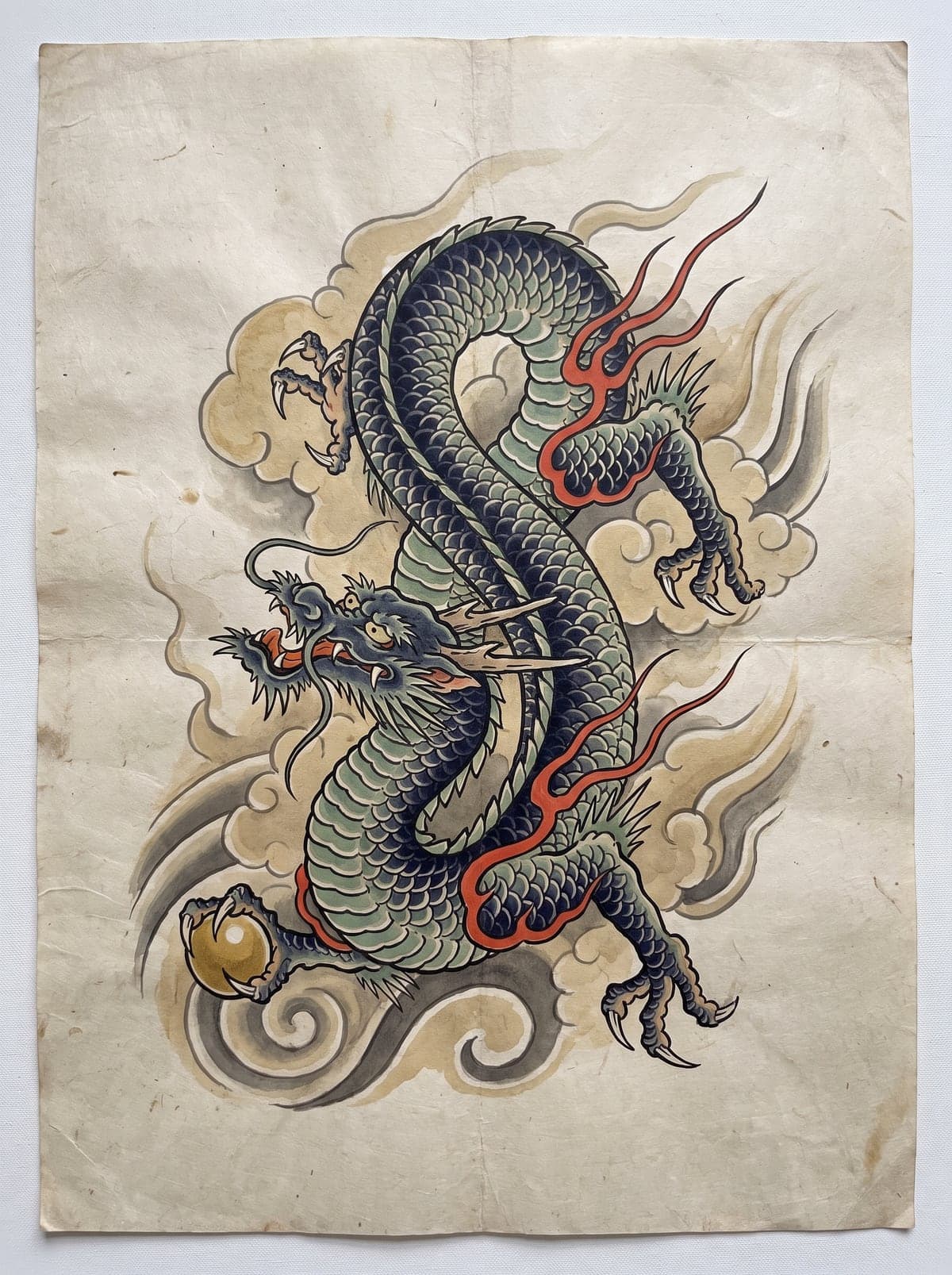
Dragon (Ryu) — original Inkeify art plate in the ukiyo-e tradition.
Meaning & Symbolism
Wisdom, strength, protection, benevolence. Unlike Western dragons, the Japanese dragon is a benevolent water deity associated with rainfall, seas, and imperial power.
The Story
Derived from Chinese lung mythology and adapted through Buddhism. Dragons guard the dharma and are associated with the four seas. In Japanese folklore, the Dragon King (Ryujin) lives in an underwater palace (Ryugu-jo) beneath the sea.
How Artists Render It
In full colour the dragon's scales are the showpiece — each one individually shaded with bokashi so the body reads as a gradient from deep green or blue along the spine to pale belly plates, with the mane, whiskers and flame accents in contrasting red or gold. In black-and-grey the scales carry everything: artists lean on tight, repetitive scale texture against smooth grey clouds so the serpentine body still pops without colour. Fine sujibori outline work matters more here than on almost any other motif — a wobbly dragon spine is unfixable.
Traditional Placement
Back + Glutes
The classic use is a full backpiece: head between the shoulder blades or over one shoulder, body coiling down through the buttocks and one thigh. On sleeves, the body should wrap the arm like rope — never run straight down it — with the head on the outer shoulder or forearm where the muscle is flattest. A dragon needs length; cramming one into a half sleeve forces tight coils that read as a knot. Give it clouds and wind bars to swim through, and keep the claws and pearl near a joint where movement animates them.
Direction: Ascending dragon (nobori-ryu) coils upward through clouds. A descending dragon (kudari-ryu) is rarer and represents a dragon returning to earth to aid humanity.