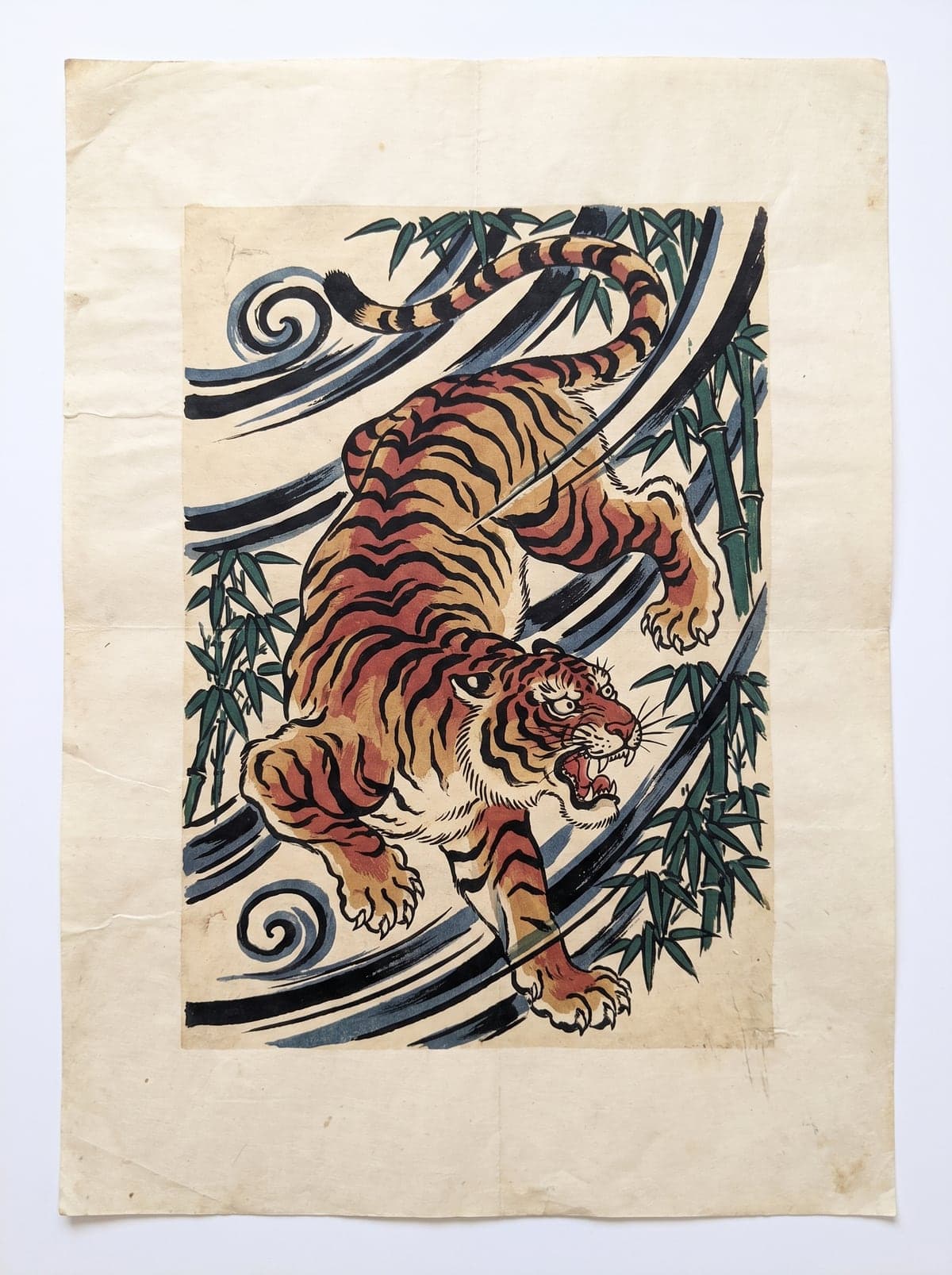
Tiger (Tora) — original Inkeify art plate in the ukiyo-e tradition.
Meaning & Symbolism
Courage, strength, long life, wind. The tiger controls the wind as the dragon controls water. Together they represent the balance of opposing forces.
The Story
Tigers were not native to Japan but entered the artistic tradition through Chinese and Korean influence. The bamboo tiger (take ni tora) motif — a tiger sheltering in bamboo during a storm — is among the most iconic pairings in Japanese art.
How Artists Render It
Colour tigers ride the contrast between saturated orange and clean white belly fur, with stripes brushed in confident single strokes — hesitant, patchy stripes are the most common failure. Black-and-grey tigers are arguably stronger: stripes become pure graphic pattern and the artist shades musculature under the fur with soft grey. Bamboo and wind backgrounds complement rather than compete. The face is everything: brow tension and bared fangs need enough scale to render properly, which is why tiny tigers so often disappoint.
Traditional Placement
Front TorsoBack + Glutes
Tigers want to move down the body — the classic descending tiger (kudari-dora) prowls down a back panel, outer thigh, or forearm with the head low and shoulders bunched. Ribcage placements let the body's curve give the tiger a stalking arc. Pair with bamboo for the wind-and-tiger idiom, or oppose it with a dragon (sky vs earth) across the body's two halves. Keep the stripes wrapping around the limb's cylinder rather than lying flat, or the fur reads as printed.
Direction: Descending tiger (kudari-tora) moves downward, complementing the ascending dragon. Traditionally placed opposite to a dragon.