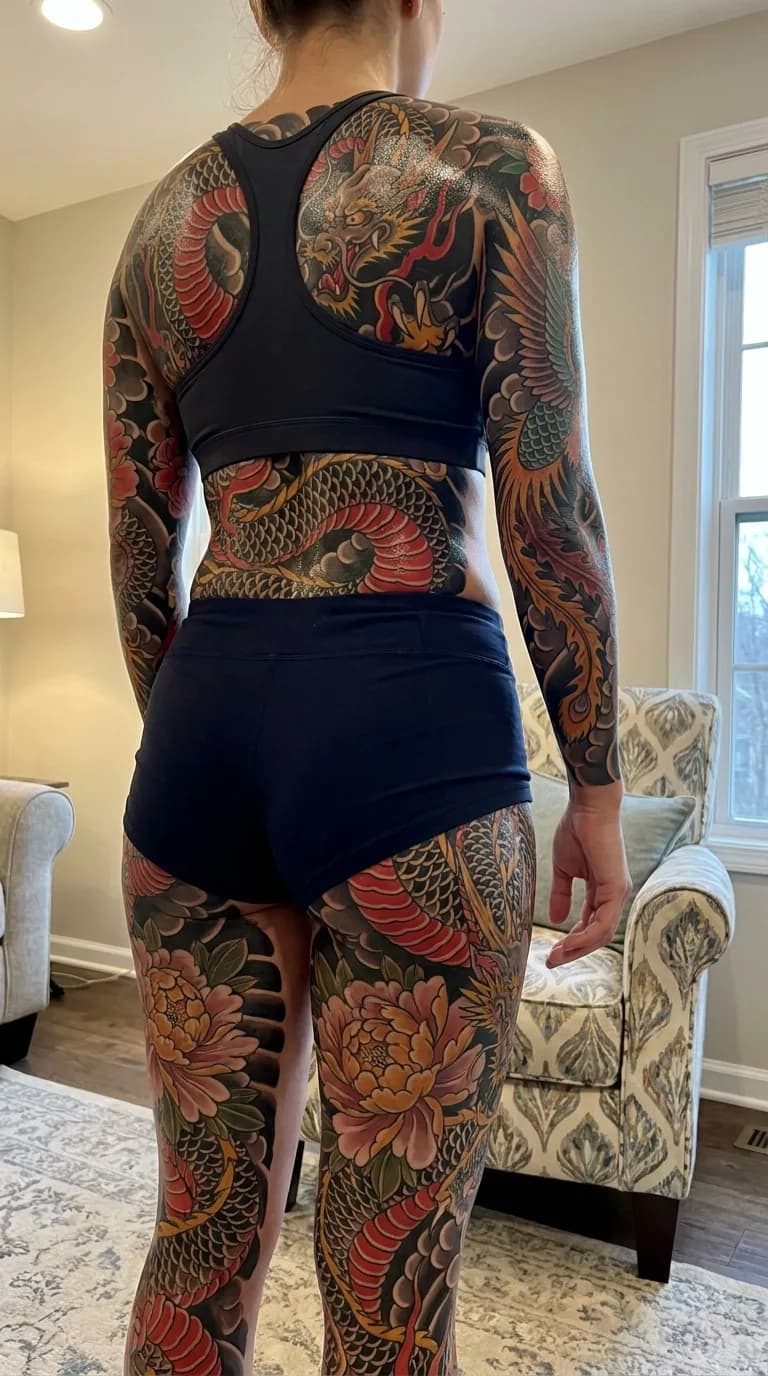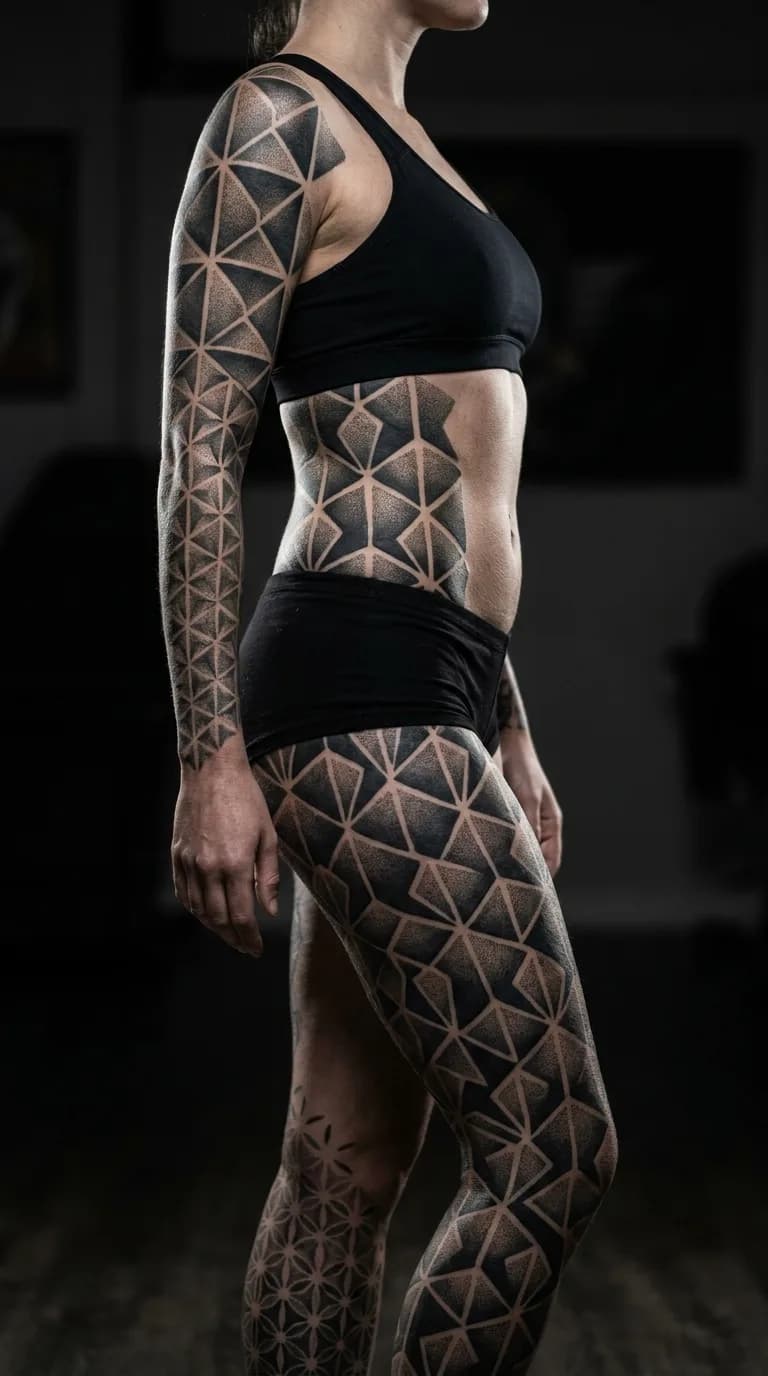
I'm Yuki. I design buildings — towers mostly, all glass and steel and structural maths. So when I decided to get a bodysuit there was genuinely no debate about the style: geometric, bilaterally symmetric, every line measured, zero freehand. Basically I wanted to apply the same fussiness I use on things that hold hundreds of people in the air to the thing that holds me. My friends think this is unhinged. They are not wrong. Here's how three years of it went.
Why symmetry (a small rant)
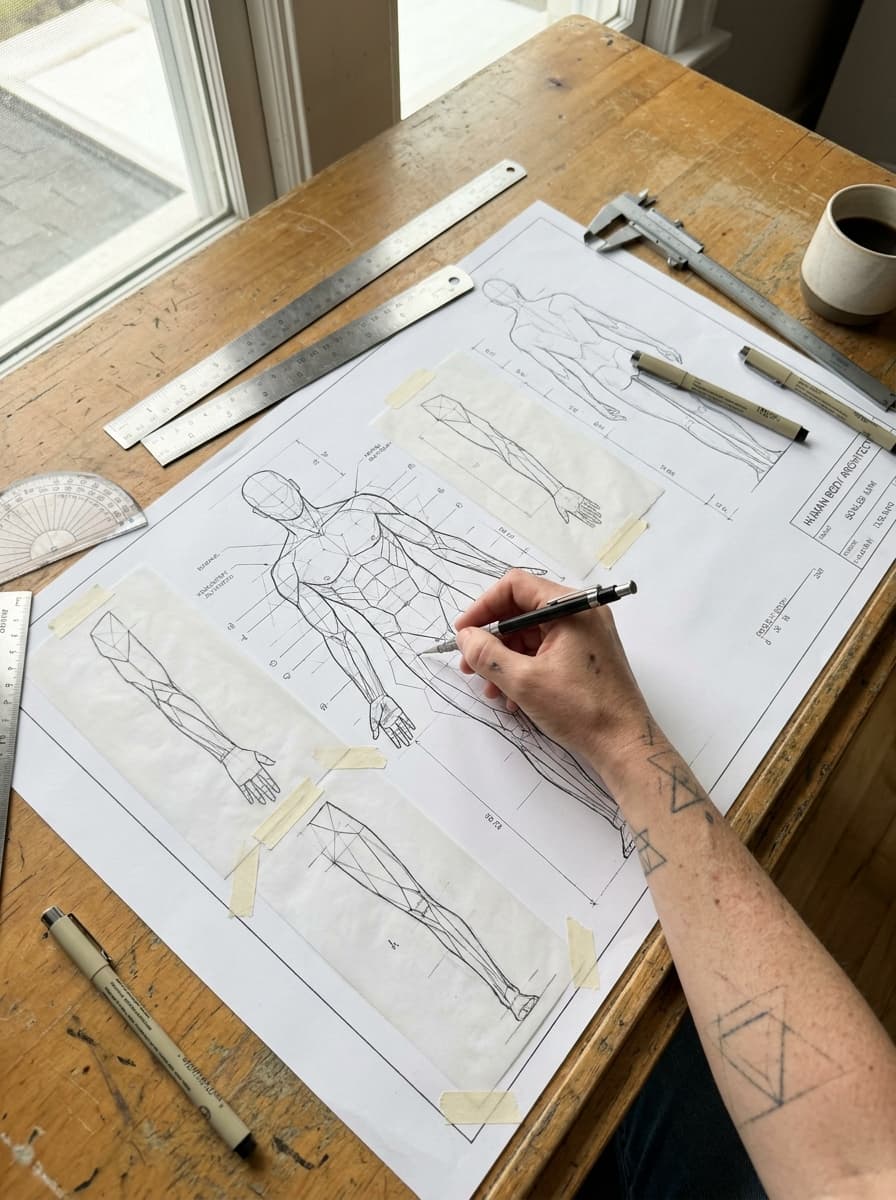
People keep asking why bilateral symmetry — why not something looser, more organic, more 'fun.' Because my entire job is precision. A column one degree off-centre isn't quirky, it's a structural problem. I wanted my suit to have that same rigour: if the hexagon on my left shoulder blade is 43mm across, the one on the right is 43mm across. Not roughly. Exactly. Marcus got it instantly — the man owns a ruler, calipers and a laser level and isn't afraid to use them. We spent four months on the blueprint before a single needle came out.
Mood: Treating this like a construction project, because it is one.
Four months of blueprint (yes, really)
Weekly meetings with Marcus. He built a full-body map: every pattern, every intersection, every transition. The spine is the main axis — interlocking hexagons from the base of my neck to my sacrum — and the sternum mirrors it on the front. Everything snaps to that grid, exactly like setting out a building. We also solved the curvature problem: a circle on flat paper becomes a stretched ellipse on a body, so he pre-distorts every pattern so it reads correct to the eye even though it's mathematically warped on the skin. This is the part most geometric work gets wrong and it's why I happily waited four months.
Mood: The maths is genuinely beautiful, fight me.
Spine axis — the foundation goes in
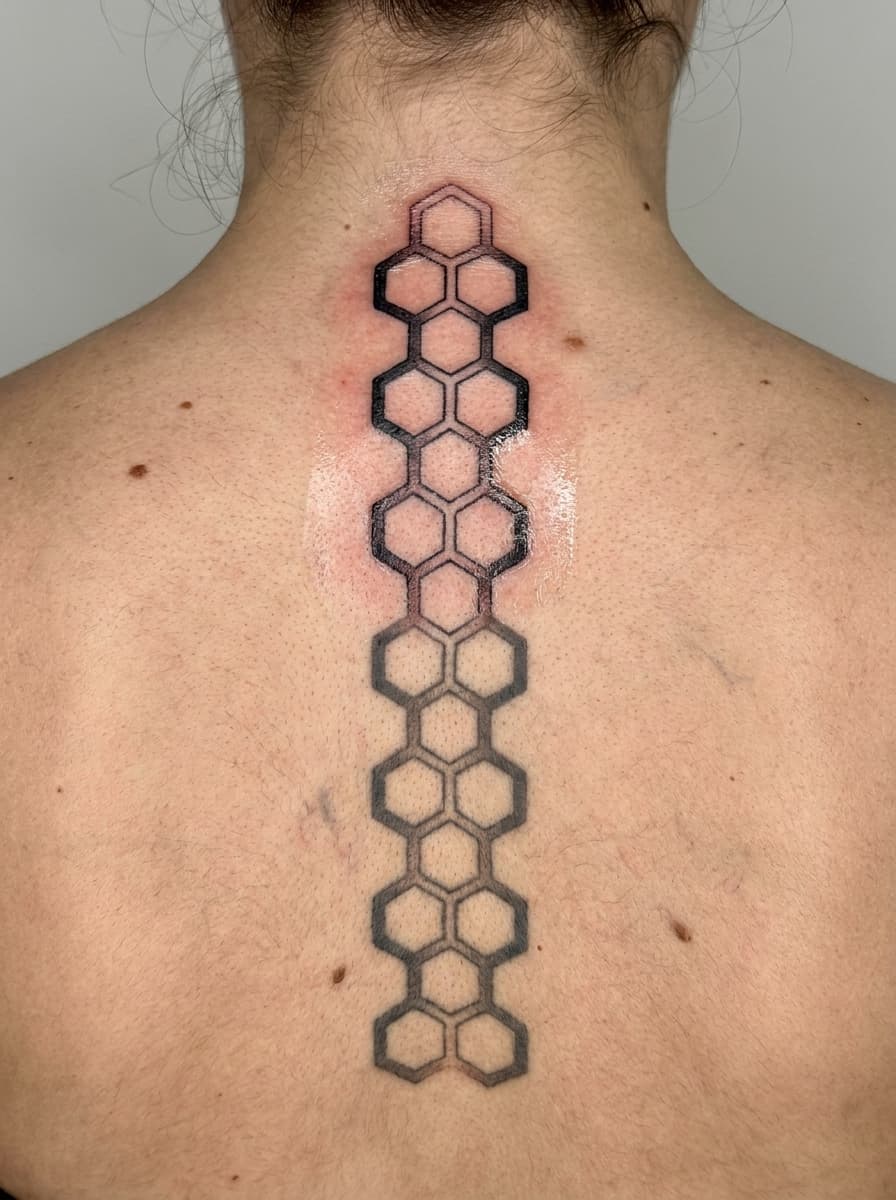
First needle on skin and suddenly it's real. Marcus starts at the big vertebra at the base of the neck and works down, hexagon after hexagon, measuring between every single one — the ruler's as busy as the machine. Two sessions to run the spine column from neck to sacrum. It's the foundation; get this wrong and everything built on it is wrong. After session two I saw a perfect line of geometry running down my back like a zip, or a structural core, and I'm not exaggerating when I say it's my favourite thing on my body.
Pain: 7/10 — straight over the vertebrae. Proper bone pain.
Healing: Clean heal, lines sharp after a couple of weeks.
Mood: Precision is weirdly soothing to me.
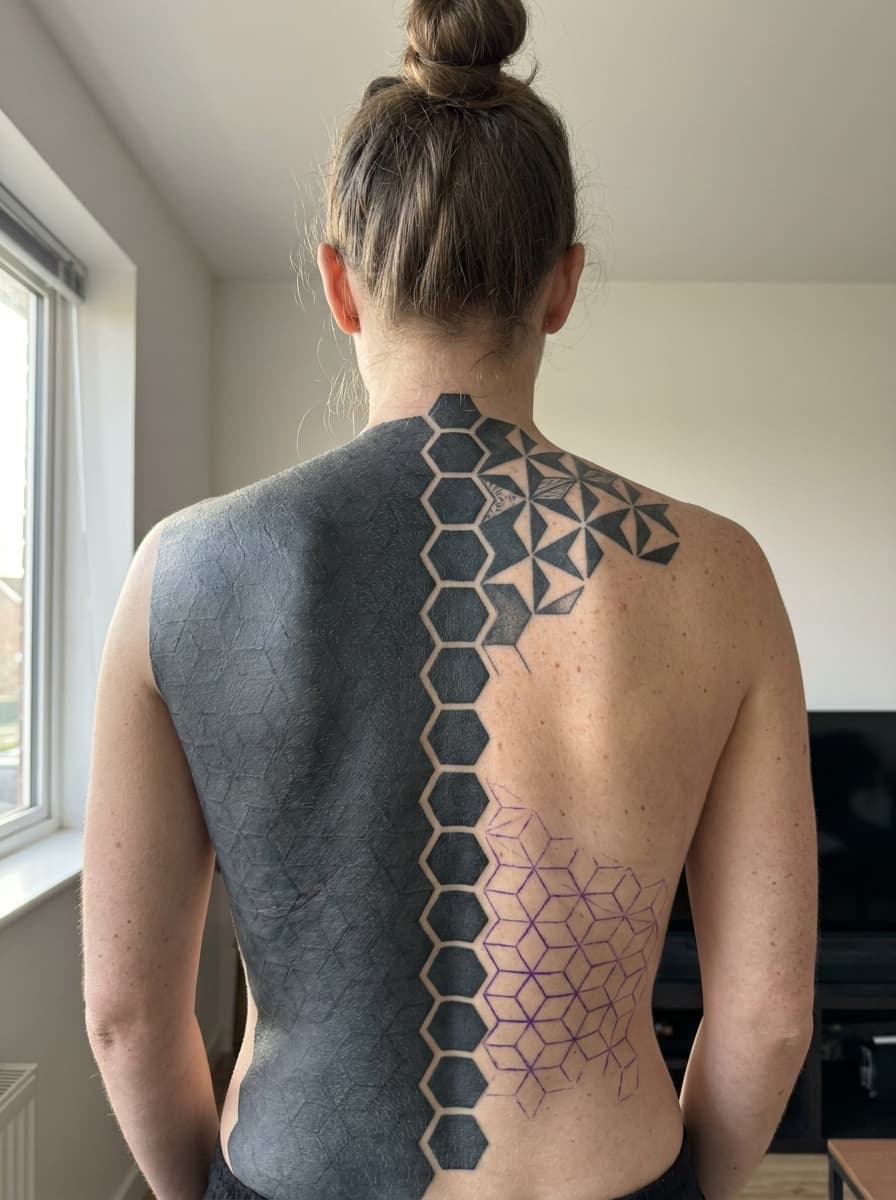
Full back — and yes I overlaid the photos in Illustrator
Radiating out from the spine. Hexagons near the centre, shifting to Penrose tiles by the ribs, to Islamic star patterns at the flanks — all derived from the same grid. Marcus re-measures after every break. I've started photographing each session and overlaying the shots in Illustrator to check symmetry myself, which Marcus finds funny and also, I think, secretly respects. Back's dense now, maybe 70% covered. Standing in the mirror I look a bit like a building facade, and I mean that as the highest compliment I'm capable of.
Pain: 6/10 — fine on the flat of the back, spicy where it wraps to the ribs.
Healing: Dialled in my routine: Saniderm 48 hours, then unscented moisturiser twice a day.
Mood: Meditative. Each session's basically a long drawing exercise.
Legs, both at once (parity is non-negotiable)
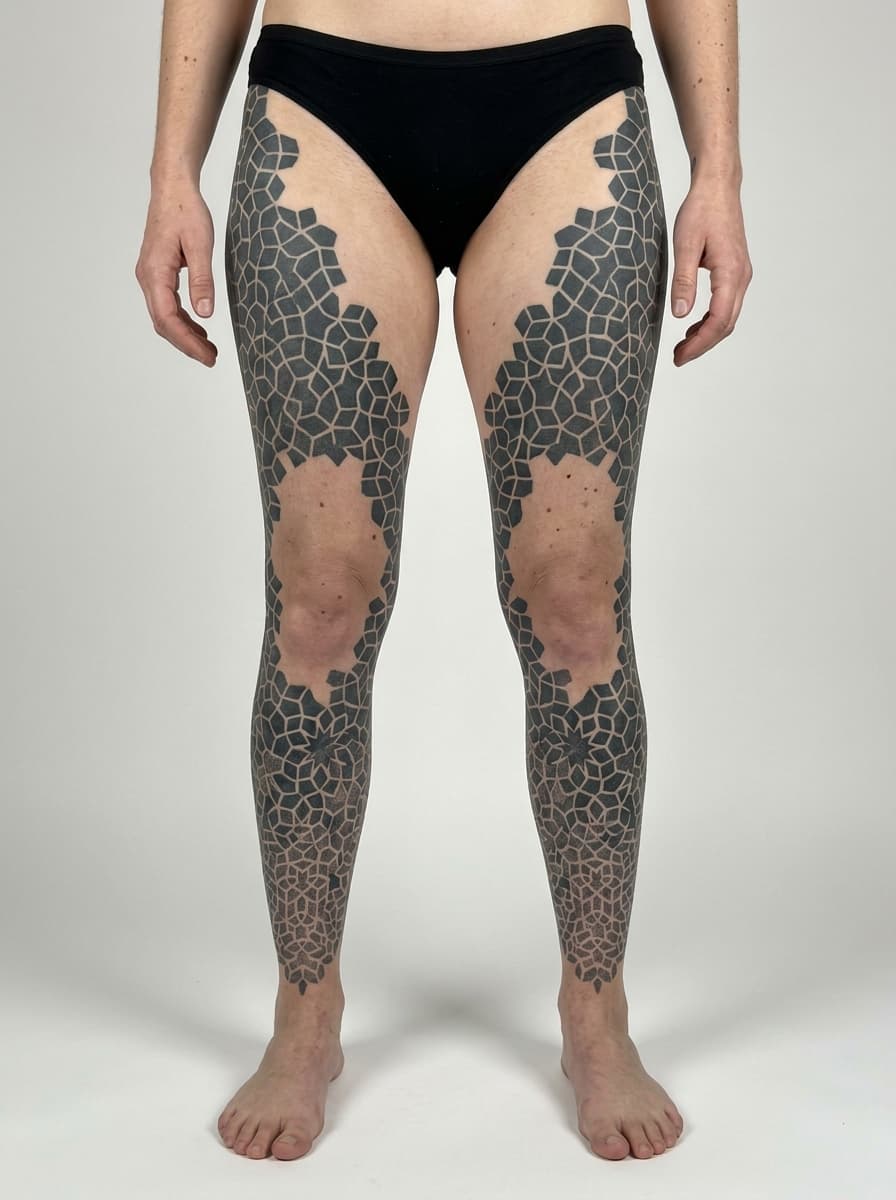
Both legs in parallel — left session, right session, alternating so neither falls behind, because if one got ahead I would lose my mind. The leg geometry flows from the hip: big tiles up top, shrinking toward the ankle, exactly how a building tapers — larger elements carry the visual weight, smaller ones add detail. By the ankle the tiles are 8mm, at the hip 35mm, scaling on a logarithmic curve. I worked the dimensions out on paper and handed Marcus the numbers for every row. He didn't even blink, which is why I love working with him.
Pain: 5/10 — outer thigh's easy. Back of the knee is genuinely dreadful.
Healing: Legs swell a lot. Living in compression sleeves between sessions.
Mood: Systematic and honestly enjoying myself.
Legs done — under 1.5mm deviation, thank you
Eighteen sessions and both legs are finished. I photographed them from identical angles and overlaid them — deviation is under 1.5mm anywhere. Marcus is basically a very precise human running a machine. The legs read as tapered architectural columns and when I wear a skirt now people stare, not at the tattoos exactly but because something about the proportions reads as deliberate and the eye gets pulled. Geometry is attention management. True in buildings, true on skin.
Healing: Fully healed, ready for arms.
Mood: Lower half complete. Quietly smug.
Left arm — built on the golden ratio
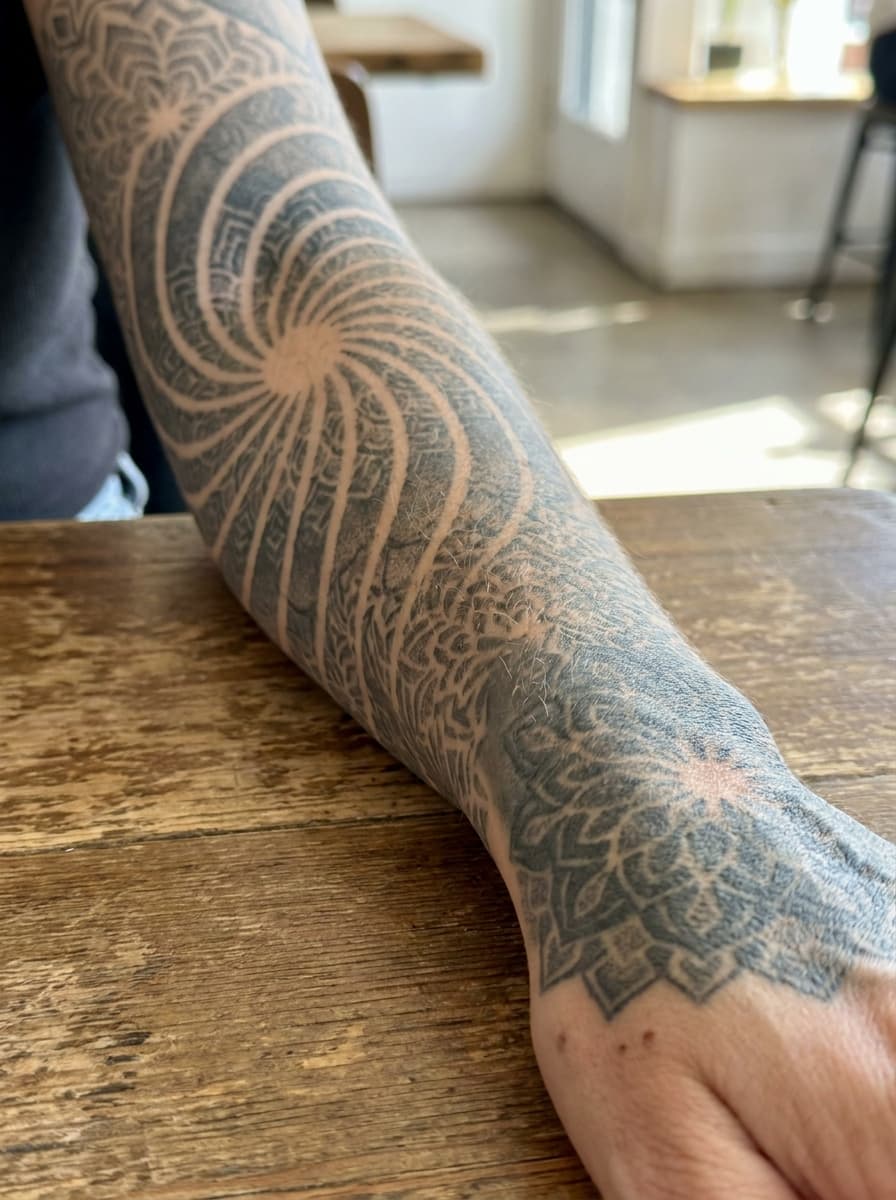
Left arm's based on the golden ratio — spirals from the elbow expanding outward following phi. Marcus drew the spiral in gold sharpie first; it wraps twice round the forearm, once round the bicep. The fill is dense mandala-ish geometry but every radial element spaces to phi, getting denser toward the wrist so the arm fades light-to-dark along its taper. People ask if both arms match. They don't. They rhyme. (I have explained the difference between matching and rhyming to several people who did not ask for it.)
Pain: 8/10 — inner elbow and wrist. The forearm bones are brutal.
Healing: Heals fast but the wrist cracked a bit during healing — had to baby it.
Mood: Genuinely excited watching the two maths families grow side by side.
Right arm — Fibonacci, because of course
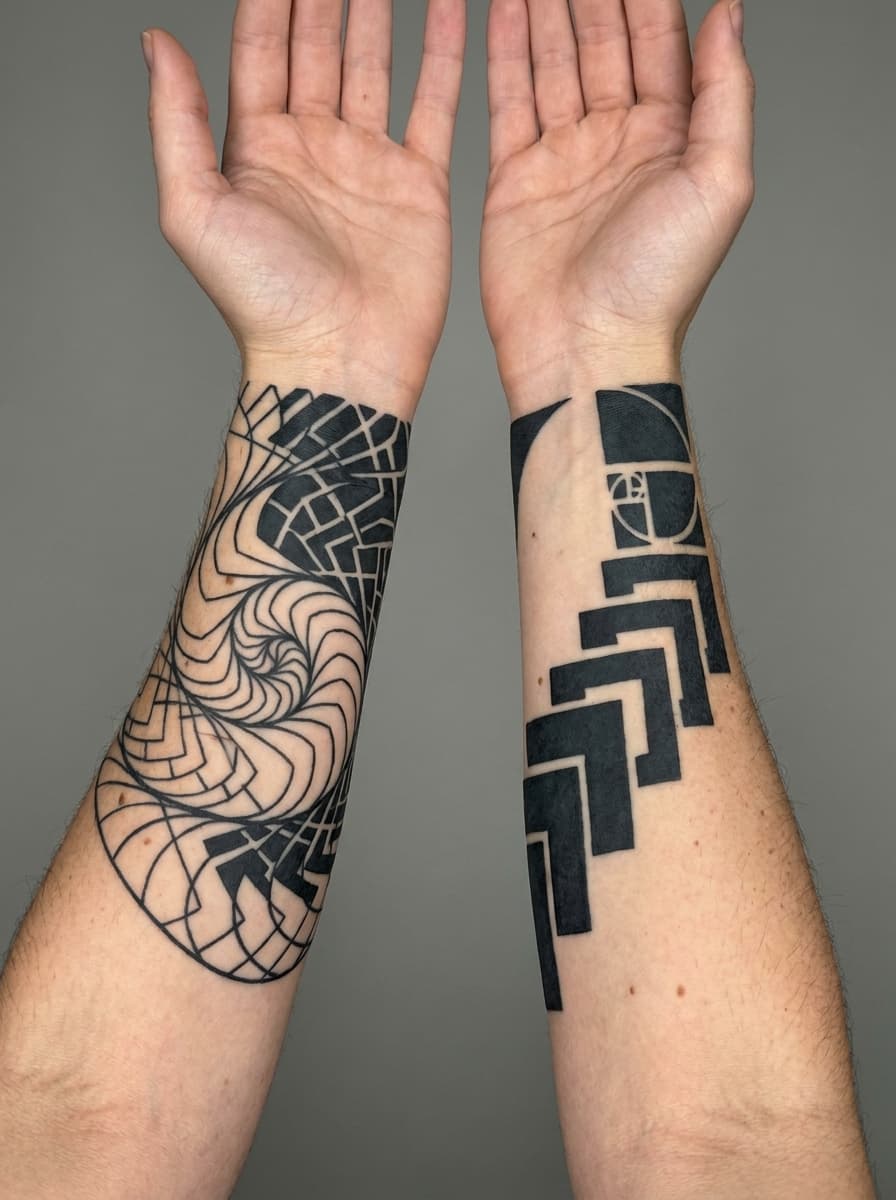
Right arm is Fibonacci. Where the left spirals smoothly to phi, the right steps up the sequence — 1, 1, 2, 3, 5, 8, 13, 21 — with tile sizes following the numbers. Marcus and I had a proper debate about whether anyone would ever notice the difference. Consciously? Probably not. But the left reads smooth and organic and the right reads stepped and rhythmic — the difference between a ramp and a staircase. Both get you to the same floor, different feeling on the way up. This is the kind of thing I think about instead of sleeping.
Pain: 8/10 — same spots as the left. No kinder the second time.
Healing: Identical to the left arm. Symmetry even in the healing, which delighted me far too much.
Mood: Pure nerd joy.
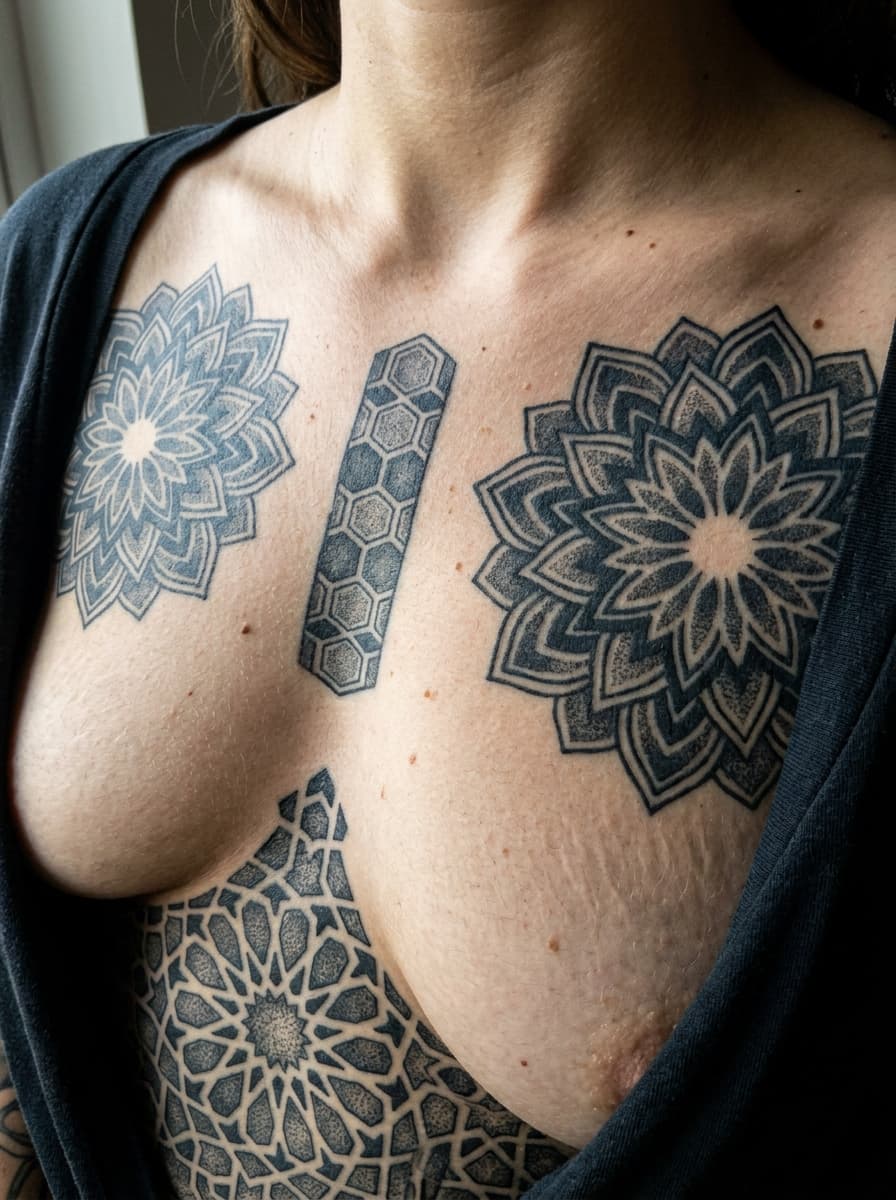
Torso — where everything finally connects
The torso is the interchange — legs to arms, spine to sternum, all routes meeting. The geometry here is Islamic-inspired: eight- and twelve-pointed stars in an interlocking lattice, each star sitting on a node where systems cross. The chest panels are the showpiece — two big mandalas with 12-fold symmetry, one each side, mirrored across the sternum. Eight sessions. The ribs were as bad as everyone promised. But watching Marcus build a mandala point by point — centre, primary radials, then the secondary geometry filling in — was honestly like watching a building go up. You see the structure appear out of nothing.
Pain: 9/10 — ribs. The chest itself was oddly okay.
Healing: Torso's awkward — no side or front sleeping, two weeks flat on my back.
Mood: Buzzing watching the whole system click together.
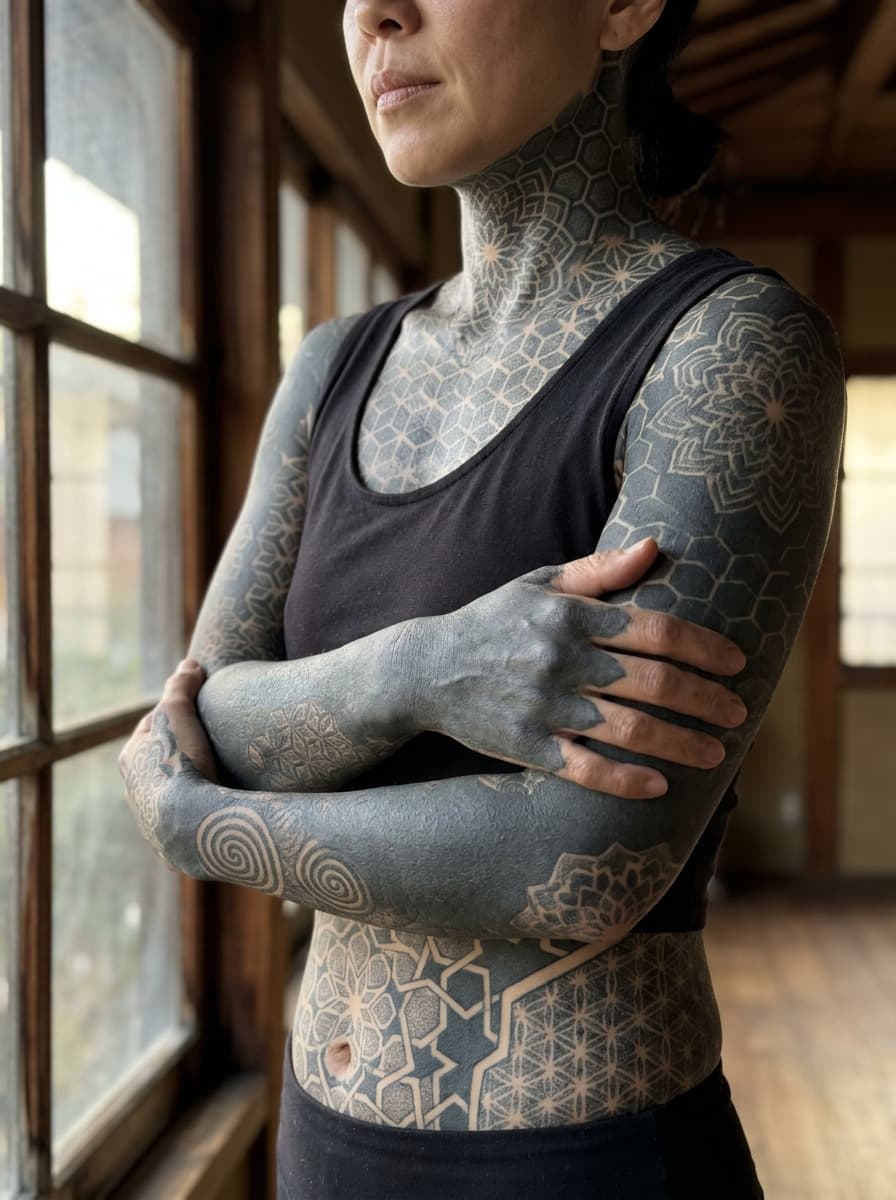
Final passes — 0.8mm and done
Three last sessions — weighting certain lines for emphasis, darkening the transitions between body sections, one final symmetry check (Marcus with calipers, me with my photo overlays, both of us being insufferable). Final number: 0.8mm max deviation across bilateral pairs. Most people can't perceive asymmetry under about 3mm, so we're roughly four times better than the eye can even detect. Three years, one month, sixty-two sessions. My whole body is now one geometric system on a grid I set in week one. I'm not going to say I 'became a building.' But it passed every inspection I could throw at it, and that's the most satisfied I've ever been with anything I've made.
Mood: Like signing off a project that cleared every check.
“Yes, I made my tattooist use calipers. No, I will not be apologising for it.”
Looking back
People assume geometric work is cold — 'you turned your body into a spreadsheet.' But every ratio was a choice. The golden spiral on my left arm is there because I think in spirals; the Fibonacci on the right because I build in steps; the symmetry because I trust that a good system holds up across the whole thing. That's not cold, it's the warmest thing I know — backing your own framework and watching it hold. If you're a precise person who's been told your taste is 'too rigid': go find a geometric artist who measures, and build the thing exactly how you want it. It held. Three years, sixty-two sessions, and it held perfectly.
Summary
Total sessions
62
Total hours in chair
~310
Duration
3 years 1 month
Coverage
~88%
Symmetry deviation
<0.8mm bilateral
Technique
Machine (precision liner + shader)
Most painful area
Ribs — 9/10
Planning phase
4 months