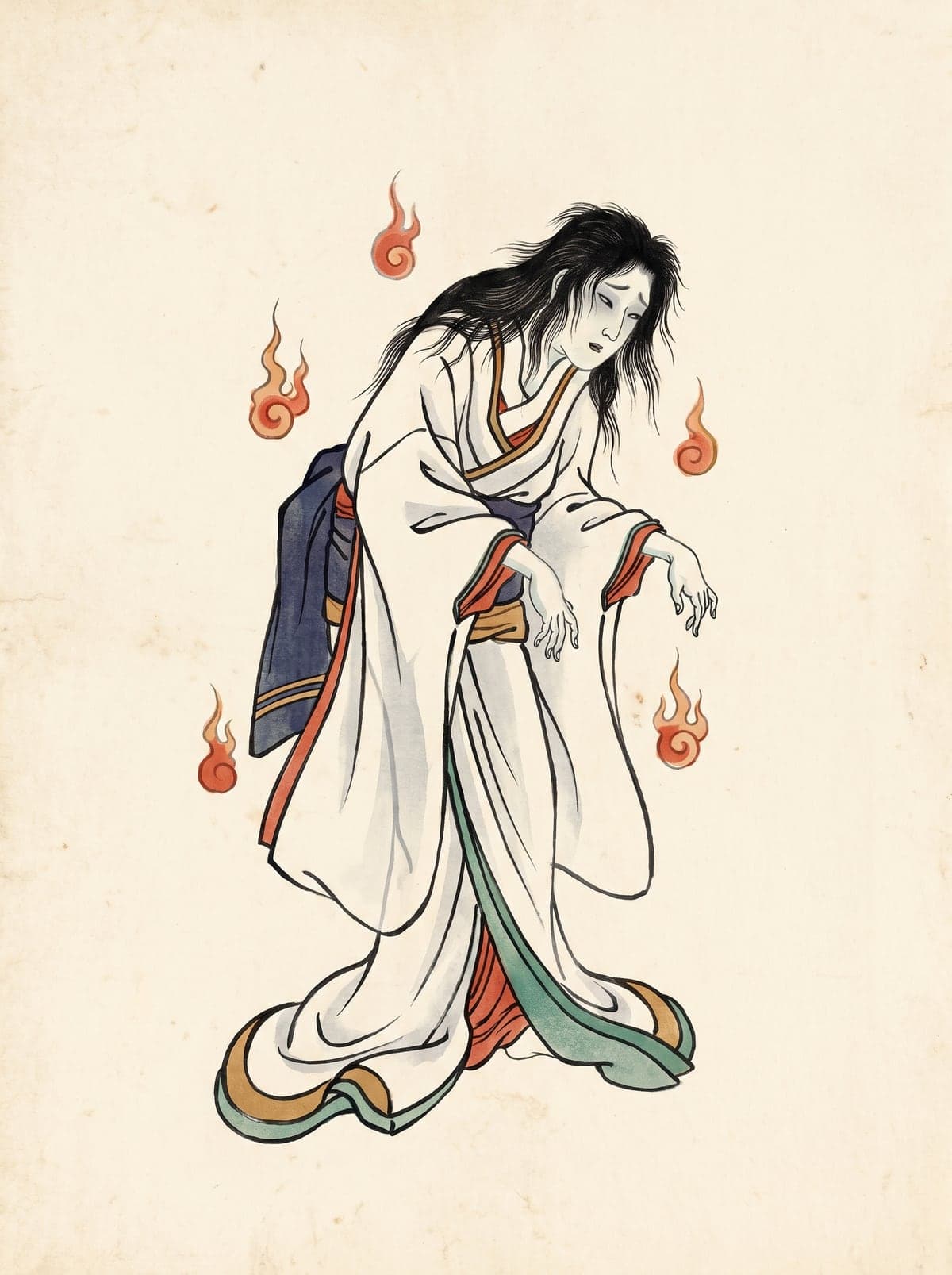
Ghost (Yūrei) — original Inkeify art plate in the ukiyo-e tradition.
Meaning & Symbolism
Unresolved attachment, vengeance, lingering emotion. Yurei are spirits trapped between worlds by powerful emotions — love, jealousy, or desire for revenge.
The Story
Unlike Western ghosts, yurei have specific visual conventions — white burial kimono, long disheveled black hair, limp hands, no feet (floating). Famous yurei include Oiwa (from Yotsuya Kaidan) whose husband poisoned her, and Okiku who counts plates endlessly at the bottom of a well.
How Artists Render It
The ghost renders in the kabuki-codified form: white burial kimono, long unbound black hair, hands limp at the wrist, and no feet — the figure dissolves into mist below the knees. The palette is nearly monochrome by design: white robe, black hair, one accent (a blue flame hitodama, a red under-robe glimpse). That restraint makes it a natural black-and-grey piece where the dissolve gradient at the hem is the technical crux. The face hovers between sorrow and menace; committing to one flattens it.
Traditional Placement
Back + Glutes
Yurei float in vertical spaces with darkness beneath — inner upper arm, ribs, the side-back — anywhere the dissolve can trail into shadow or existing black background work. Willow branches, lantern light and hitodama flames are the canonical accompaniments. It's a mourning motif as much as a horror one: many wearers carry a specific loss in it, and artists often personalise the kimono's crest. Keep it away from busy high-colour zones; the ghost needs quiet around it.
Direction: Floating upward without feet, hair flowing, spectral and translucent.