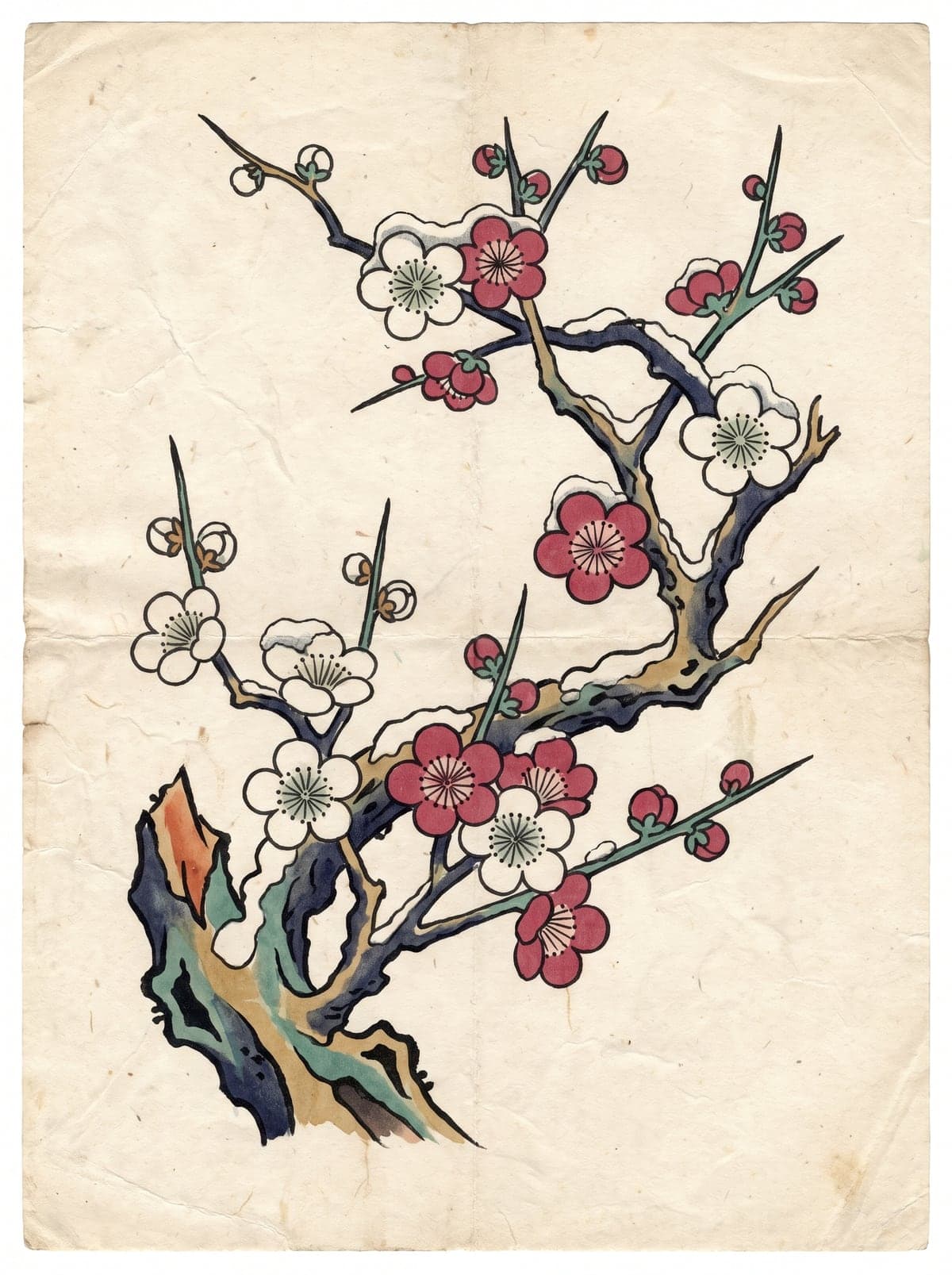
Plum Blossom (Ume) — original Inkeify art plate in the ukiyo-e tradition.
Meaning & Symbolism
Resilience, renewal, the approach of spring. The plum blooms before all other flowers, sometimes while snow still lies on the ground — representing endurance and the first sign of hope after winter.
The Story
Before cherry blossoms became dominant, plum blossoms were the most celebrated flower in Japan. They were imported from China and associated with scholarly refinement. The plum, pine, and bamboo together form 'shōchikubai' — the three friends of winter.
How Artists Render It
Ume render as small round five-petalled blossoms — more compact and geometric than sakura — on distinctively angular, almost calligraphic black branches, often with snow still on them. That branch structure is the piece: gnarled, elbowed lines against which the round blossoms sit like notes on a stave. White and deep pink-red are the traditional blossom tones. In black-and-grey the angular branch does even more work, and the blossoms often go negative-space. Distinguish it from sakura deliberately: rounder petals, harder branches, sparser bloom.
Traditional Placement
Front TorsoBack + Glutes
Plum suits precise, linear spaces — along the collarbone, tracing the spine's upper line, down a forearm — where the branch's angular architecture can be featured rather than crowded. Its winter-defiance meaning (first bloom in snow) makes it the flora of perseverance suits, pairing with nightingales, snow texture and moon disks. Wearers often choose ume over sakura precisely to signal endurance rather than transience — the two flowers argue opposite theses about beauty.
Generate AI tattoo designs featuring Plum Blossom in seconds — irezumi, blackout, or blackwork. Plan your full bodysuit with stage-by-stage AI guidance.