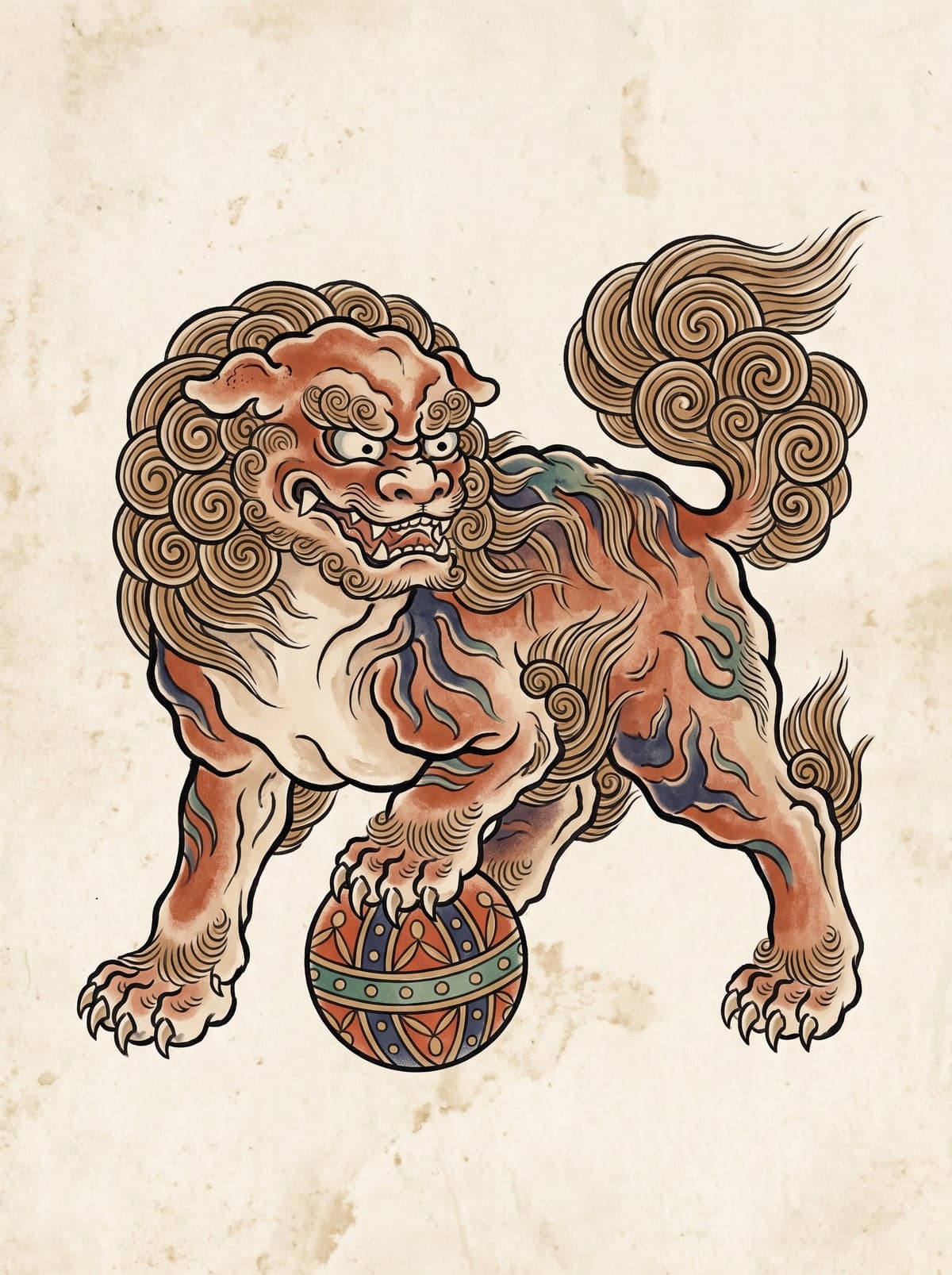
Guardian Lion (Shishi / Komainu) — original Inkeify art plate in the ukiyo-e tradition.
Meaning & Symbolism
Protection, courage, strength. Guardian lions ward off evil spirits and protect sacred spaces. Often shown in pairs — one with mouth open (a-gyo) and one closed (un-gyo).
The Story
Derived from Chinese shi and adapted through Buddhism. Found at temple and shrine entrances throughout Japan. The open mouth speaks the first sound of the Sanskrit alphabet (a), the closed mouth the last (un), together representing the beginning and end of all things.
How Artists Render It
The guardian lion's curled mane is the motif — tight spiral curls covering mane, tail and leg feathering, each curl outlined and shaded individually. Colour treatments run the mane in green, blue or gold against an earth-toned body; the karajishi-botan pairing adds pink and red peonies for contrast. Black-and-grey shishi rely on the curl pattern's rhythm and deep shadow under the jaw and brow to keep the face fierce. Flat, lazy curls collapse the whole piece — this is one of the most technique-revealing motifs in the tradition.
Traditional Placement
Front TorsoBack + Glutes
Shishi anchor shoulders and chest panels superbly: the traditional karajishi sits on the deltoid with peonies cascading down the upper arm, the mane's curls following the shoulder's roundness. As guardian figures they're often placed in mirrored pairs across the body — one shoulder each, or flanking a backpiece's central figure. Face direction matters: compose the lion looking outward from the body's centreline, guarding, never inward. Rocks and peony backgrounds tie it in; water does not suit it.
Direction: Typically shown seated or in a powerful stance, often with a ball (tama) or peony beneath one paw.
Generate AI tattoo designs featuring Guardian Lion in seconds — irezumi, blackout, or blackwork. Plan your full bodysuit with stage-by-stage AI guidance.