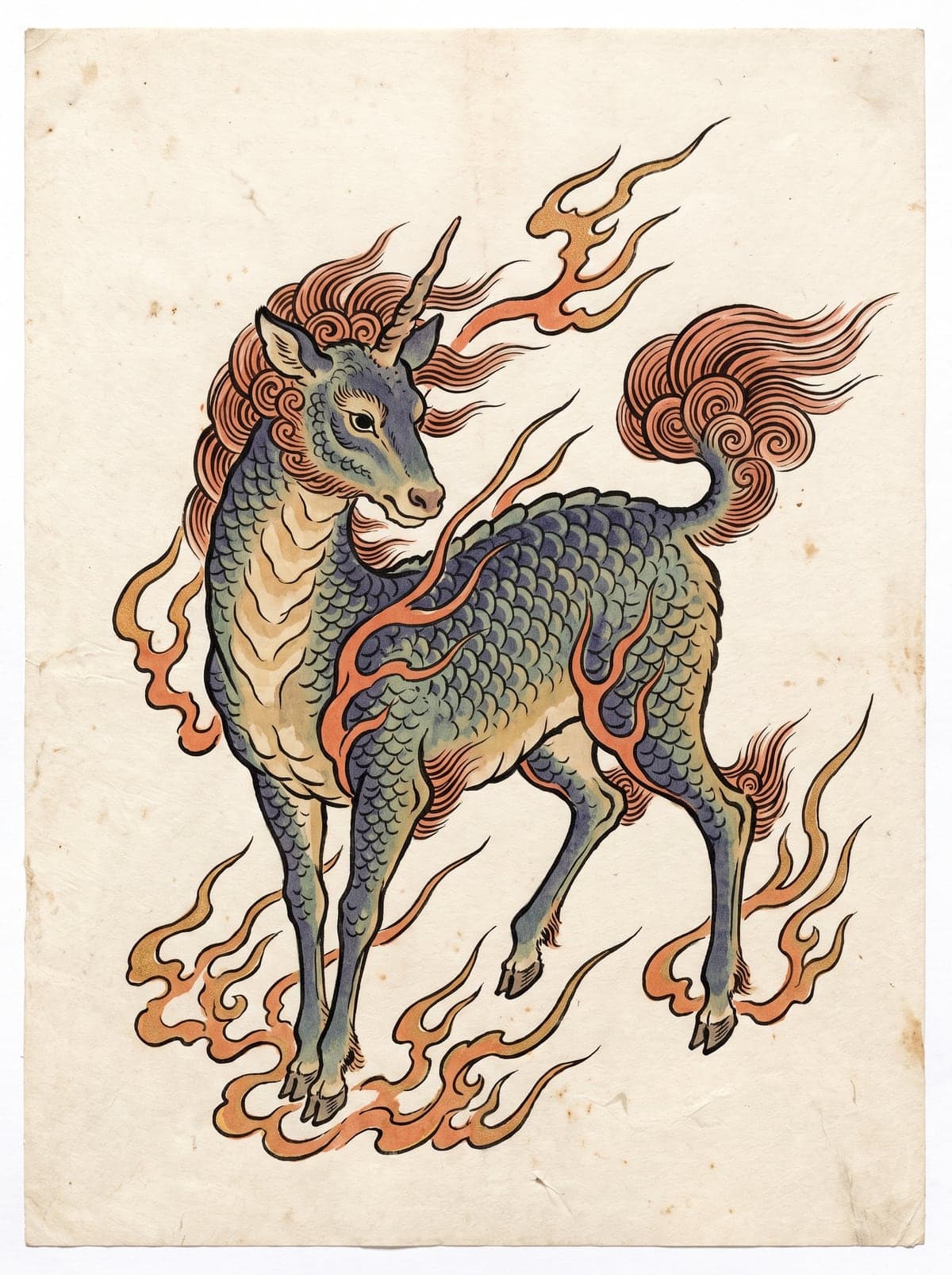
Kirin (Kirin) — original Inkeify art plate in the ukiyo-e tradition.
Meaning & Symbolism
Good fortune, serenity, prosperity. The kirin appears only to herald the arrival or death of a great sage or ruler. It is so gentle it will not step on living grass.
The Story
A chimeric beast with the body of a deer, tail of an ox, hooves of a horse, and a single horn. Covered in scales or brilliant fur. Associated with Confucian virtue and benevolent rule.
How Artists Render It
The kirin mixes dragon scale texture with a deer's body and flame accents at the joints, so colour treatments usually anchor on a single body tone — often blue-grey or white — and let the mane and flames carry red and gold. In black-and-grey the flame licks around the hooves and mane give artists their contrast, rendered with soft edge-fade so they read as light, not solid shapes. The single horn and dignified face need portrait-level care: a kirin with a mean or bland face loses the entire point of the motif.
Traditional Placement
Back + GlutesFront Torso
A kirin works beautifully as a chest-to-shoulder panel or a thigh piece, standing or mid-leap with clouds beneath the hooves — it is a sky creature and shouldn't be grounded on rocks or water. Backpieces show it in full stride. Because the kirin embodies serene judgment, compositions face it calmly forward or slightly upward; a downward-lunging kirin reads wrong to anyone who knows the iconography. Flame details at the joints want placement over muscle that flexes, where the flicker comes alive.
Direction: Typically shown standing or walking gently, sometimes surrounded by flames that harm nothing.