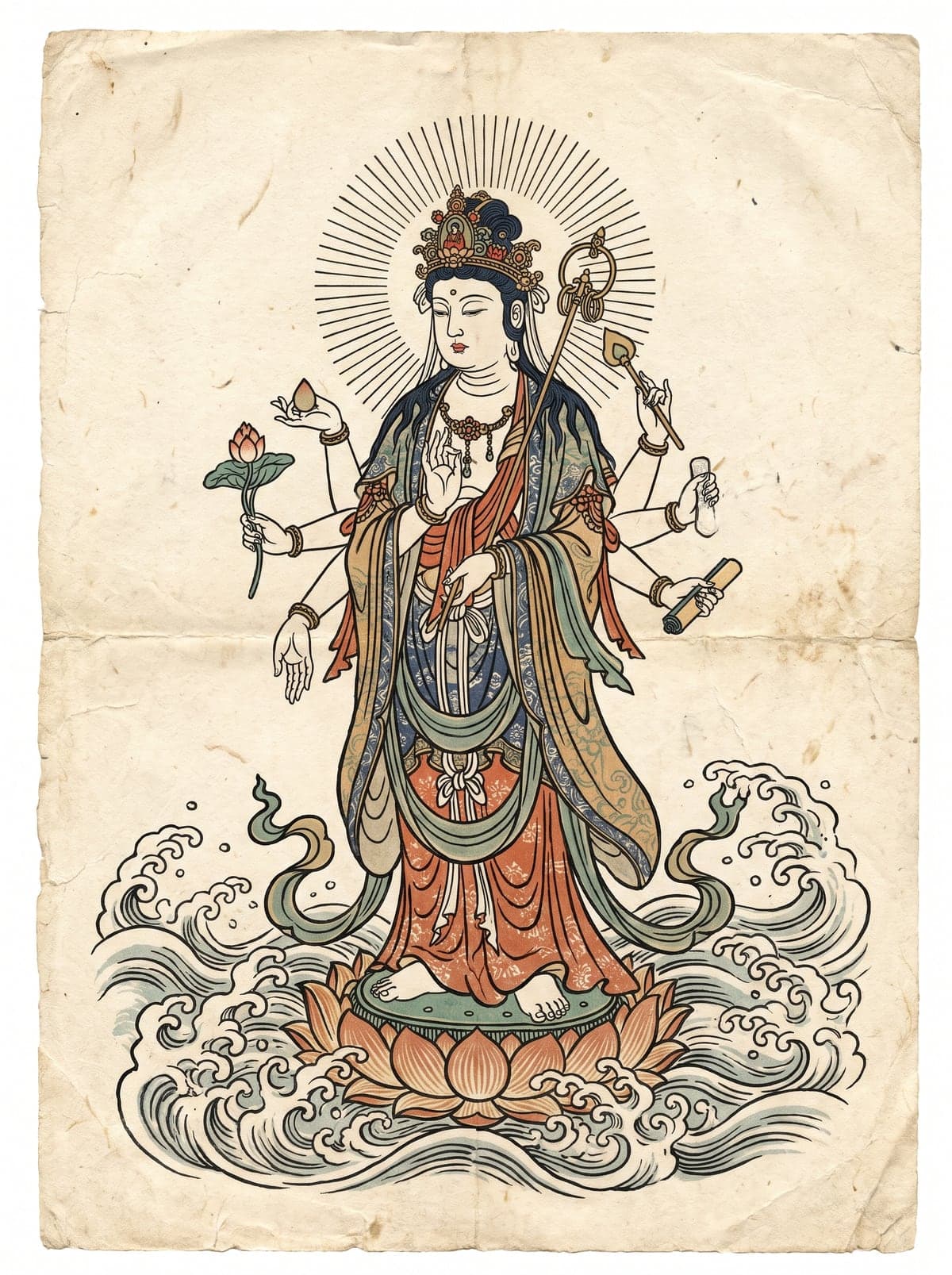
Kannon (Kannon Bosatsu) — original Inkeify art plate in the ukiyo-e tradition.
Meaning & Symbolism
Mercy, compassion, infinite kindness. Kannon hears the cries of all sentient beings and responds with compassion. One of the most beloved figures in Japanese Buddhism.
The Story
The bodhisattva of compassion (Avalokitesvara in Sanskrit). Kannon takes many forms — the 1,000-armed Senju Kannon, the 11-headed Juichimen Kannon, and the horse-headed Bato Kannon. Each form addresses different types of suffering.
How Artists Render It
Kannon is rendered with deliberate serenity — smooth gradient skin, downcast merciful eyes, flowing robes whose fold-work carries most of the technical load, a lotus or vase in hand. Colour treatments stay muted: whites, soft golds, pale blue-greys, so the face's calm dominates. Black-and-grey Kannon are among the most beautiful pieces in the tradition, all soft grey transitions and fine robe lines. The face is the entire piece — a millimetre of asymmetry in those closed-calm features is visible from across a room.
Traditional Placement
Back + Glutes
Kannon takes the back's centre or a full rear thigh/calf panel, composed vertically and almost always framed by a halo arc, lotus base, or descending clouds. As with Fudō, placement etiquette applies — she goes high and central, never on lower-status zones. She pairs with dragons (as her mount in one iconographic form), lotus, and waterfall backgrounds. This is also a memorial motif; many wearers choose her for a specific person, and artists often build subtle personal references into the robe pattern.
Direction: Serene standing or seated posture, often on a lotus, sometimes riding waves (Fudaraku Kannon).
Convention avoids composing Kannon alongside Oni Demon (Oni) and Severed Head (Namakubi) — seasonal or symbolic clashes an experienced irezumi artist will flag at consultation.
Design your Kannon tattoo
Generate AI tattoo designs featuring Kannon in seconds — irezumi, blackout, or blackwork. Plan your full bodysuit with stage-by-stage AI guidance.