Soushinbori — the full-length bodysuit 総身彫り
Soushinbori (総身彫り, "whole-body carving") is the full-length format of the Japanese tattoo bodysuit: coverage runs down the arms to the wrist and down the legs to the ankle, leaving only the hands, feet, neck and groin bare. It is the most complete of the standard horimono length formats — everything else (shichibu, gobusode, mijikame) is defined by how far short of it the coverage stops.
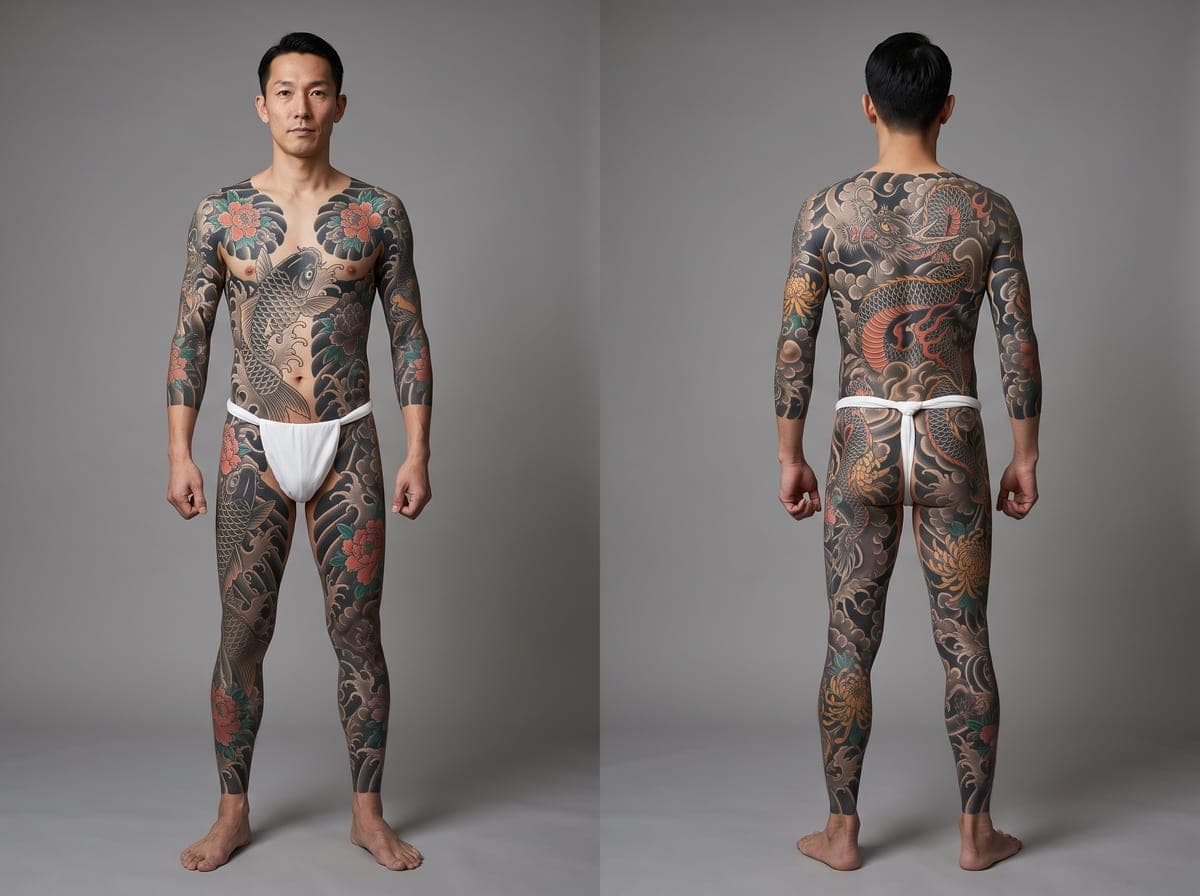
What soushinbori covers
A soushinbori suit is planned as one composition across the whole body: a dominant back piece (often begun as kame no koh, the 'turtle back'), sleeves that run to the wrist, leg coverage to the ankle, and gakubori background — waves, clouds and wind bars — filling every gap so the suit reads as a single design rather than a collection of pieces. The front of the torso is cut one of two ways: donburi (completely filled) or munewari (a bare channel down the centre).
Soushinbori donburi vs soushinbori munewari
The length format and the front cut are independent choices. Soushinbori donburi fills the entire front — chest and stomach — with no bare centre, rising to a continuous tattooed collar; it is the most complete bodysuit there is. Soushinbori munewari keeps the full arm and leg length but leaves the traditional bare strip down the centre front, so the suit can disappear under an open-necked shirt.
How it compares to the shorter formats
Shichibu (七分, seven-tenths) stops a few inches below the elbow and knee. Gobusode (五分袖, half) stops above the elbow and knee — fully hidden by a T-shirt and shorts. Mijikame is shorter still, with cap sleeves and mid-thigh coverage. None of these are lesser suits; they are deliberate formats with their own names, chosen for concealment, climate and taste. The full taxonomy — with front-and-back reference photos of every format — is in our bodysuit types guide.
Commitment, in plain terms
A soushinbori project is measured in years of regular sittings, not sessions. It is also the format where planning matters most: the back piece anchors the composition, and every later stage (sleeves, legs, front) has to flow from it. That is exactly the planning problem a preview tool solves — you can see the complete suit on a body, in your chosen motifs, before the first outline session.
Frequently asked
What does soushinbori mean?
総身彫り translates roughly as "whole-body carving" — the full-length bodysuit format, running to the wrists and ankles.
Is soushinbori the same as horimono?
No. Horimono is the umbrella word for traditional Japanese full-body tattooing as a unified composition; soushinbori is one specific length format of it — the longest.
Does a soushinbori suit include the hands and neck?
Traditionally no — the hands, feet, neck and groin stay bare, which is what lets even the fullest suit disappear under clothing.
Keep reading
- Irezumi bodysuit types — the complete format guide (with photos)
- Munewari vs donburi — the two front cuts 胸割り vs どんぶり
- Gobusode — the half-length suit 五分袖
- Gakubori — the background that makes it a suit 額彫り
- Horimono — the bodysuit tradition itself 彫り物
- Japanese irezumi tattoo designs — style overview & gallery
See it on your own body first
Pick a format and motifs, then generate photorealistic previews of the complete suit — free to start.
Try it free